How to Choose Leverage: A Beginner’s Guide
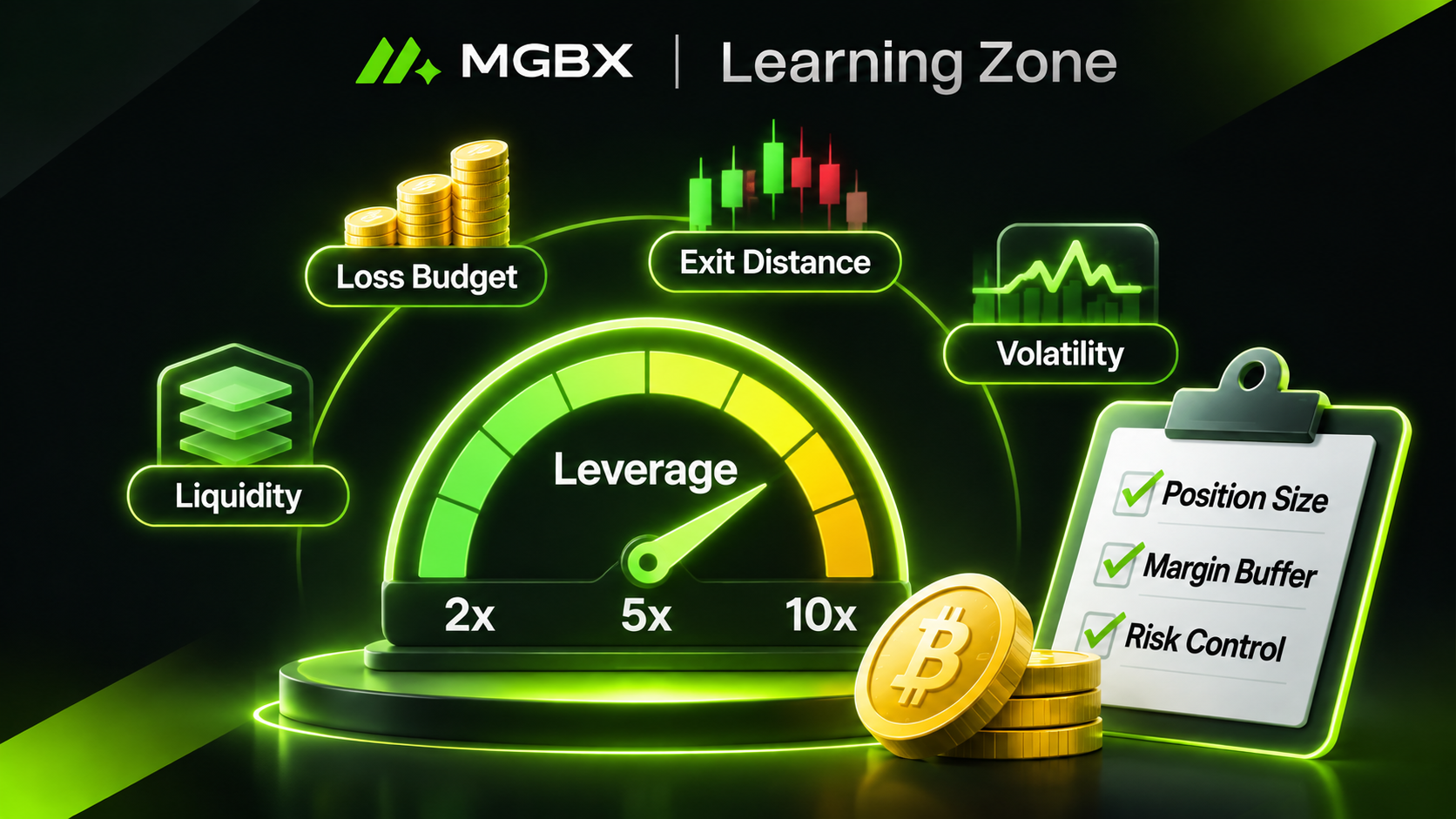
Choosing leverage starts with an acceptable loss limit, followed by position sizing based on your planned exit distance, then an assessment of margin requirements and liquidation buffers. No leverage level is safe for every beginner, asset, or trading timeframe. Even low leverage can produce substantial losses if the position is too large. Effective risk management considers volatility, liquidity, holding costs, and correlated positions. Beginners can learn through simulated or small trades rather than increasing leverage based on time spent trading or short-term profits.
Why Should Position Size Come Before Leverage?
The same leverage setting can produce very different account risks. With account equity of 1,000 quote-currency units, allocating 100 units of margin at 5x leverage creates a position worth 100 × 5 = 500 units. Allocating 500 units at 2x leverage creates a position worth 500 × 2 = 1,000 units.
For the same percentage price movement, the second position generates larger gains or losses. Risk management therefore requires assessing exposure relative to account equity, not simply choosing a lower multiplier. CME Group’s position management guidance emphasizes sizing positions around risk scenarios rather than the maximum trading size permitted by the platform.
How Do You Calculate Position Size from a Loss Budget?
This educational example is not a universal allocation recommendation. Suppose account equity is 1,000 units and the planned loss budget per trade is 10 units. Reserve 2 units for fees and slippage, leaving 8 units to absorb adverse price movement.
If the planned exit is 2% away from the entry price, the opening position value for linear futures can be estimated as:
Position Value = Loss Budget for Price Movement ÷ Exit Distance
The position value is therefore approximately 8 ÷ 2% = 400 units.
At 2x leverage, basic margin is approximately 400 ÷ 2 = 200 units.
At 4x leverage, basic margin is approximately 400 ÷ 4 = 100 units.
Both create the same position and produce the same profit or loss from a given price movement, but margin usage and liquidation buffers may differ.
Check whether liquidation could occur before your planned exit, and allow room for execution differences. This method supports planning; it does not guarantee that actual losses will stay within 10 units.
How Do Timeframe, Volatility, and Liquidity Affect Your Choice?
Longer holding periods require accounting for potential price swings and ongoing costs, but they do not dictate a universal leverage level. Short-term trades can also face price gaps and limited liquidity. A shorter holding period does not automatically justify higher leverage.
If increased volatility requires a wider exit distance, position size should decrease when the loss budget stays unchanged. In less liquid markets, pay closer attention to slippage and execution. A tight stop-loss is not, by itself, a reason to increase exposure.
Positions with similar directional exposure should also be assessed together. Different tokens may fall simultaneously during a market decline, so trading more pairs does not necessarily diversify risk. Beginners should understand these scenarios before adjusting leverage.
FAQ
Is 2x or 3x leverage safe for beginners?
Not necessarily. Position size, margin mode, volatility, and exit arrangements still matter.Can major cryptocurrencies safely support high leverage?
No. Better liquidity does not eliminate sharp price movements or liquidation risk.Does lowering the leverage setting reduce position risk?
Not entirely. With position quantity unchanged, the profit or loss from a given price movement usually stays the same.How often should I increase leverage?
There is no fixed schedule. Adjustments should reflect risk tolerance and product knowledge, not how many months you have traded.
Mastering the basics is the first step. Follow MGBX Academy to access more cryptocurrency educational resources and market opportunities.
The process for trading on MGBX:
Register a trading account and complete the necessary identity verification;
Deposit funds and select a trade type;
On the cryptocurrency trading page, enter the amount or quantity of the cryptocurrency you wish to purchase;
Confirm the order to complete the trade, and check that your assets have increased accordingly.
Further Readings:
The Complete Beginner’s Guide to Leverage Trading
What Is Leverage? A Double-Edged Sword for Returns
Margin Explained: Initial Margin and Maintenance Margin
Margin Ratios and Risk Ratios: Monitoring Your Positions in Real Time