Complete Guide to Market Orders: Speed, Benefits, and Risks
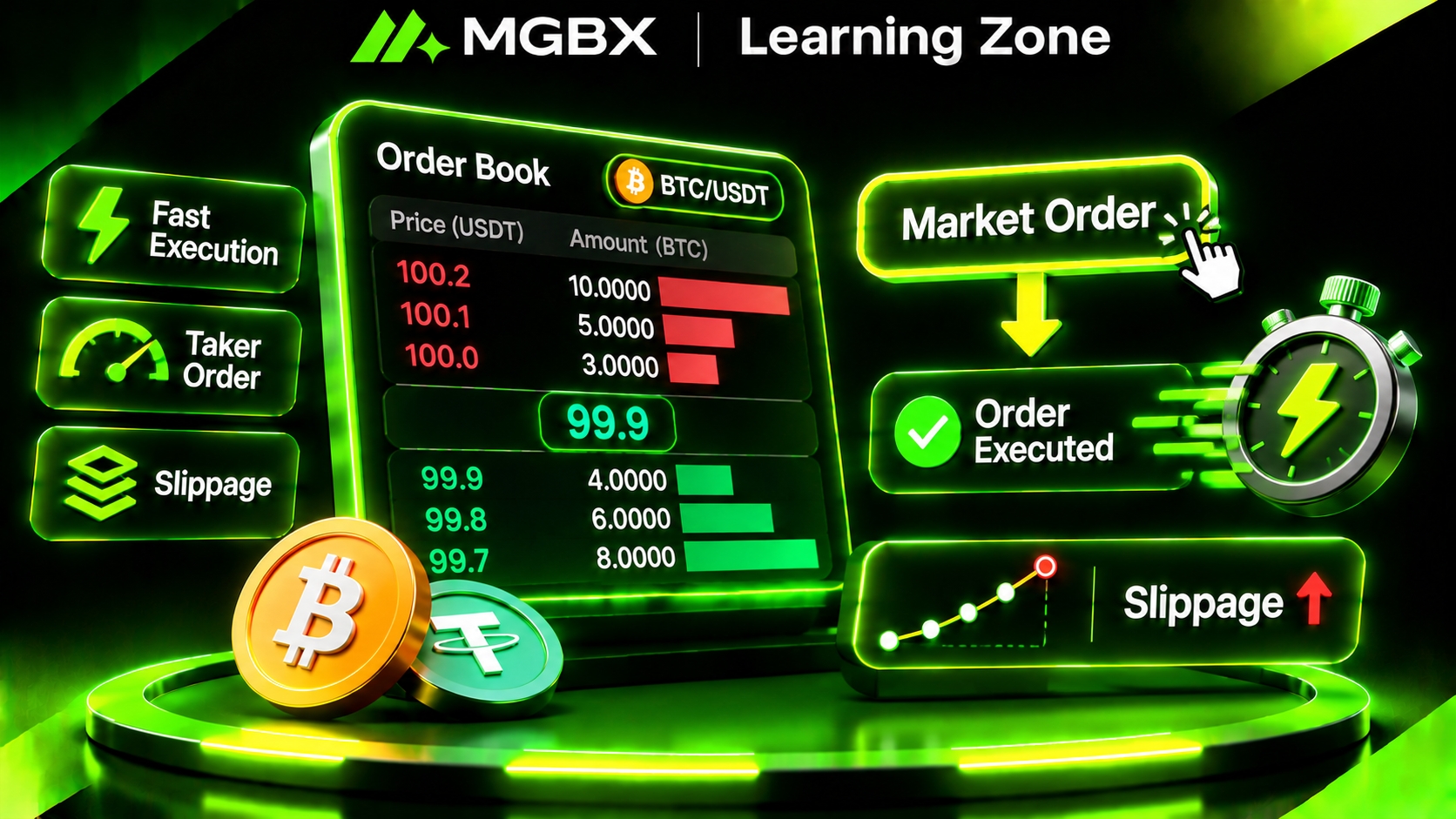
The defining feature of a market order is that it prioritizes execution rather than locking in a specific price. Once submitted, the order is matched against the best available prices in the order book. In a liquid market, this usually allows trades to be completed quickly. However, when prices move rapidly, the order size is large, or the order book is thin, the final average execution price may differ significantly from the quote shown at the time the order was placed. Understanding the relationship between market execution and slippage is key to using market orders properly.
What Is a Market Order?
A market order is an order designed to complete a trade as quickly as possible using the best available prices in the market. Unlike a limit order, users generally do not set a fixed execution price in advance. Instead, they enter the amount or quantity they want to buy or sell, and the system matches the order against available liquidity in the order book.
For example, suppose the current sell orders are:
Price: 100 USDT, 3 tokens available, total value 300 USDT;
Price: 100.1 USDT, 5 tokens available, total value 500.5 USDT;
Price: 100.2 USDT, 10 tokens available, total value 1,002 USDT;
If a user places a market order to buy 10 tokens, the trade may be filled as follows: 3 × 100 + 5 × 100.1 + 2 × 100.2 = 1,000.9 USDT. The average execution price would therefore be approximately 100.09 USDT per token.
This means that market execution does not necessarily mean the entire order will be filled at the latest price shown on the screen.
Why Do Market Orders Usually Execute Faster?
Once submitted, a market order immediately looks for existing orders in the order book that can be filled, rather than waiting for the market to reach a specified price. For this reason, market orders typically remove liquidity from the order book and are commonly considered Taker orders.
When a trader is more concerned with entering or exiting the market quickly than with achieving a specific price, a market order offers a clear execution advantage. In a liquid market, a relatively small order may be completed within a short period, with only a limited difference between the average execution price and the best available quote.
However, prioritizing execution does not guarantee a particular price. That trade-off is one of the main considerations when using a market order.
What Is Slippage, and Why Does It Happen With Market Orders?
Slippage generally refers to the difference between the expected price and the actual execution price.
Suppose an asset is showing a latest price of 100 USDT, but only a small amount is available for sale near that price. If a user places a larger market buy order, the system may need to continue matching the order against sell orders at 100.1, 100.3 USDT, or higher. As a result, the final average execution price could rise to 100.2 USDT.
Slippage does not necessarily indicate a problem with the trading system. It is often the result of market liquidity, order size, and price movement working together.
Three situations deserve particular attention: a trading pair with limited liquidity, an order size that is significantly larger than the quantity available at the best price, and periods of rapid price movement during major market events.
When Should You Consider Using a Market Order?
A market order may be more suitable when execution speed is the priority and the trader accepts that the final price may differ from the quote shown before the trade.
By contrast, if a specific price is important to the trading plan, a limit order may be more appropriate because it allows the user to define an acceptable price range.
Before placing a larger market order, it can also be useful to review market depth and check how much liquidity is available at different price levels.
A market order is not inherently more advanced or more dangerous than other order types. It simply reflects a clear trade-off: less price certainty in exchange for a higher probability of immediate execution.
FAQ
Will a market order always execute immediately?
Under normal liquidity conditions, market orders usually execute quickly. However, extreme market conditions, insufficient liquidity, or changes in platform status may affect execution.Why is my average market order price higher than the price I saw?
The order may have matched against several sell-price levels, resulting in slippage and a higher average execution price.Is a market order always a Taker order?
In most cases, yes. A market order typically removes existing liquidity from the order book and therefore acts as a Taker.What is the main difference between a market order and a limit order?
A market order prioritizes execution speed, while a limit order prioritizes price control.How can I reduce the impact of slippage on a large market order?
You can review market depth in advance and, depending on the situation, consider splitting the order or using a limit order. The appropriate approach depends on market conditions and your trading plan.
Mastering the basics is the first step. Follow MGBX Academy to access more cryptocurrency educational resources and market opportunities.
The process for trading on MGBX:
Register a trading account and complete the necessary identity verification;
Deposit funds and select a trade type;
On the cryptocurrency trading page, enter the amount or quantity of the cryptocurrency you wish to purchase;
Confirm the order to complete the trade, and check that your assets have increased accordingly.
Further Readings:
Complete Guide to Spot Trading
What Is Spot Trading? The Simplest Way to Buy Crypto
How Spot Trading Works: A Detailed Guide
Complete Guide to Limit Orders: Trading With Greater Price Control
Stop-Loss and Take-Profit Orders: Essential Tools for Risk Management