Complete Guide to Futures Trading: From Beginner Basics to Risk Management
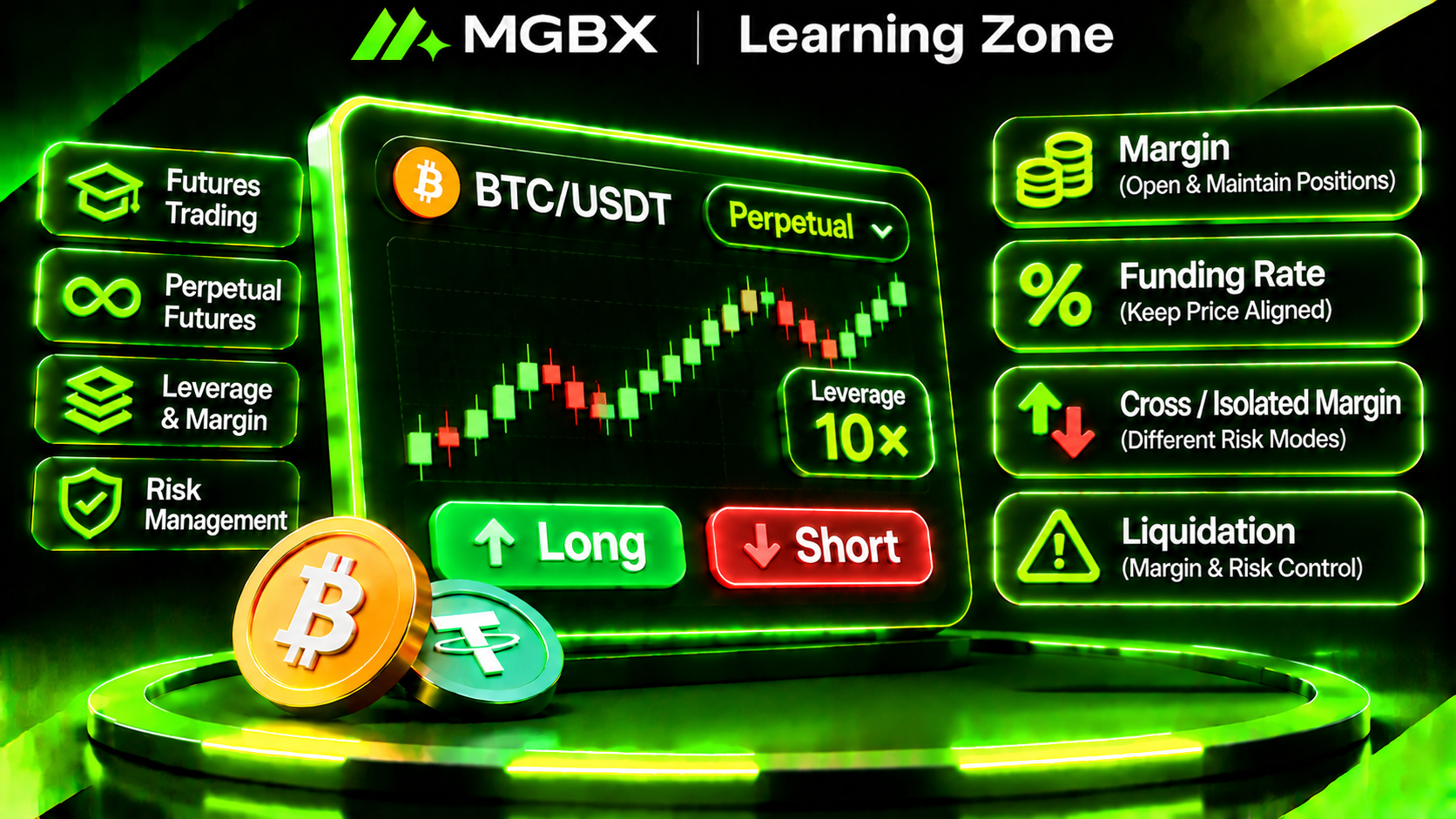
Futures trading is a form of derivatives trading in which profit and loss are determined by changes in the price of an underlying asset. It typically supports both long and short positions as well as leverage. Perpetual futures are especially common in crypto because they have no fixed expiry date. For beginners, understanding margin, funding rates, liquidation, and position sizing is just as important as predicting market direction.
What Is Futures Trading: Positions, Margin, and Long vs Short
Futures trading involves taking a position based on changes in the price of a digital asset rather than simply buying and holding the asset itself. Traders can open long positions when they expect prices to rise or short positions when they expect prices to fall, making futures a two-way trading instrument.
Margin is the capital used to open and maintain a futures position. Traders generally do not need to provide the full notional value of a position. Instead, they use margin to control a larger position, which creates leverage.
For example, under simplified conditions and excluding fees, funding payments, and other costs, 1,000 USDT of margin at 5x leverage could control a position worth approximately 5,000 USDT. If the underlying asset moves 2% against the position, the unrealized loss would be about 100 USDT, or roughly 10% of the initial margin. This illustrates how leverage can amplify both potential gains and losses.
Beginners should also understand concepts such as mark price, liquidation price, maintenance margin, and unrealized PnL. Liquidation does not simply occur when all initial margin has been lost. It depends on maintenance margin requirements and the platform’s risk management rules.
Why Do Perpetual Futures Have No Expiry Date?
Perpetual futures are one of the most common types of crypto derivatives. Unlike expiry-based futures, perpetual futures do not have a fixed settlement date. As long as a position continues to meet margin requirements and is not closed or liquidated, it can theoretically remain open.
Because there is no expiry date, perpetual futures require mechanisms that help keep their market price aligned with the underlying spot reference price. One of the most important is the funding rate. In general, when the funding rate is positive, long positions pay short positions. When it is negative, short positions typically pay long positions.
Funding can affect the cost of holding a position. Rates, settlement frequency, and calculation methods may vary by contract, so traders should always refer to the real-time information shown on the relevant MGBX futures trading page.
Margin mode also affects position risk. Cross margin generally allows eligible positions to share available margin within a defined account scope, while isolated margin keeps the margin assigned to each position relatively separate.
To learn more, read What Is Futures Trading: Perpetual vs Delivery Futures, What Is a Funding Rate? How Perpetual Futures Stay Anchored to Spot Prices, and Cross Margin vs Isolated Margin: Choosing a Margin Mode.
Futures Trading Is Ultimately About Managing Risk
Higher leverage does not automatically mean higher expected returns. More importantly, it increases position exposure relative to the margin committed. With higher leverage, even a relatively small adverse price move can have a larger impact on available margin.
Effective risk management therefore requires traders to consider position size, margin level, leverage, stop-loss placement, and overall account exposure rather than focusing only on potential returns.
Perpetual futures may also involve trading fees, funding payments, and slippage. During periods of high volatility or low liquidity, the actual execution price may differ from the expected price. Evaluating the true profit or loss of a futures trade therefore requires considering both price movement and trading costs.
For beginners, determining how much they can afford to lose before deciding on position size and leverage is generally more important than searching for the “best” leverage ratio. For more details, read Leverage Trading Explained: Higher Returns, Higher Risk.
FAQ
What is the main difference between futures trading and spot trading?
Spot trading generally involves directly buying and holding an asset. Futures trading is based on changes in the underlying asset’s price and typically supports long positions, short positions, and leverage, resulting in a more complex risk structure.Can perpetual futures be held indefinitely?
Perpetual futures have no fixed expiry date, but positions are still affected by margin requirements, liquidation risk, funding payments, and market conditions. They cannot be held indefinitely under all circumstances.Why are futures positions liquidated?
Liquidation may occur when a position or account no longer meets maintenance margin and other risk requirements. The exact rules depend on the relevant contract and trading platform.Does higher leverage always mean higher returns?
No. Leverage amplifies both gains and losses, while higher leverage generally leaves less room for adverse price movements.What should beginners learn before trading futures?
Start with leverage, margin, mark price, liquidation, funding rates, and the differences between cross and isolated margin before moving on to more advanced trading strategies.
Mastering the basics is the first step. Follow MGBX Academy to access more cryptocurrency educational resources and market opportunities.
The process for trading on MGBX:
Register a trading account and complete the necessary identity verification;
Deposit funds and select a trade type;
On the cryptocurrency trading page, enter the amount or quantity of the cryptocurrency you wish to purchase;
Confirm the order to complete the trade, and check that your assets have increased accordingly.
Further Readings:
What Is Futures Trading: Perpetual vs Delivery Futures
Leverage Trading Explained: Higher Returns, Higher Risk
What Is a Funding Rate? How Perpetual Futures Stay Anchored to Spot Prices