What Is Futures Trading: Perpetual Futures vs Delivery Futures
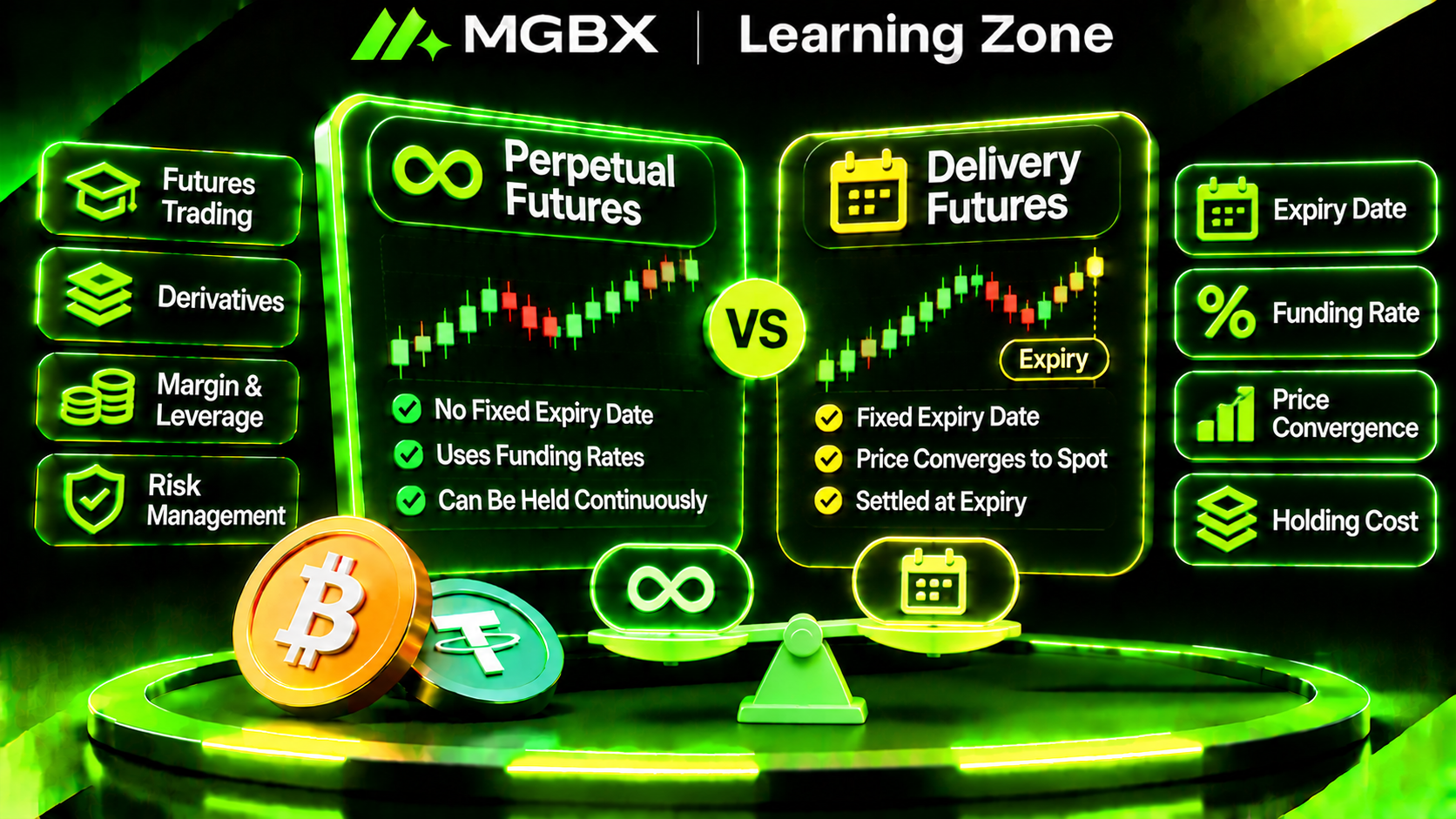
Perpetual futures and delivery futures are two common types of crypto derivatives, but they differ significantly in contract duration, pricing mechanisms, and holding costs. Delivery futures have a fixed expiry date, and their prices generally converge toward the spot reference price as settlement approaches. Perpetual futures have no fixed expiry and primarily rely on mechanisms such as funding rates to keep prices aligned with the spot market. Understanding how these contract types are structured is an essential foundation for futures trading.
What Different Types of Futures Have in Common
To understand what futures trading is, it helps to start with derivatives. The value of a futures contract is derived from price movements in an underlying asset such as Bitcoin or Ethereum. Traders can take long or short positions to gain exposure to market movements without necessarily holding an equivalent amount of the underlying asset.
Futures typically use a margin system. By posting only a portion of the position value as margin, traders can open positions with a larger notional value. This can improve capital efficiency, but it also introduces additional risks, including liquidation.
Based on contract duration, crypto futures can generally be divided into perpetual futures and delivery futures with fixed expiry dates. Both allow traders to gain exposure to price movements, but their price-anchoring mechanisms and holding structures differ.
If you are new to futures, start with Complete Guide to Futures Trading: From Beginner Basics to Risk Management before exploring the differences between contract types in greater detail.
Perpetual Futures vs Delivery Futures
Perpetual futures have no fixed expiry date. As long as margin requirements are met, a position can theoretically remain open indefinitely. To prevent perpetual futures prices from drifting too far from the spot reference price, the market typically uses mechanisms such as funding rates to adjust the cost of holding long and short positions.
Delivery futures, by contrast, have a defined expiry date. As settlement approaches, their prices generally converge toward the corresponding spot or index reference price. At expiry, the contract is settled according to the platform’s specified settlement rules.
The two contract types can be summarized as follows:
Comparison | Perpetual Futures | Delivery Futures |
Expiry Date | No fixed expiry date | Fixed expiry date |
Price Anchoring | Funding rates and related mechanisms | Expiry settlement encourages price convergence |
Funding Rate | Usually applies | Typically no perpetual-style funding rate |
Holding Period | Can remain open continuously | Limited by the contract expiry date |
Key Considerations | Funding rates, margin, liquidation | Basis, expiry date, settlement rules |
Specific product mechanisms may vary across trading platforms, so traders should always review the rules for the relevant contract before trading.
Choosing a Contract Type: Duration and Real Trading Costs
One advantage of perpetual futures is that traders do not need to manage a fixed settlement date. However, this does not mean that long-term positions are free of holding costs. If a position remains open through a funding settlement period, the trader may pay or receive funding depending on the applicable funding rate.
Delivery futures typically do not use the same recurring funding mechanism as perpetual futures, but they may trade at a premium or discount to the spot reference price. This difference is known as the basis. Traders holding a position close to expiry must also consider the settlement time and the contract’s specific settlement rules.
For this reason, neither perpetual futures nor delivery futures are inherently superior in every market environment or trading strategy. Short-term traders may focus more on liquidity and transaction costs, while longer-term hedging strategies may place greater emphasis on contract duration, basis, and settlement arrangements.
Regardless of the contract type, traders using leverage should consider margin requirements, liquidation price, position size, and market volatility.
FAQ
Why do perpetual futures have no delivery date?
Perpetual futures use mechanisms such as funding rates to help keep contract prices relatively aligned with spot reference prices, reducing the need for a fixed expiry settlement process.What happens when delivery futures expire?
Open positions are generally settled at expiry according to the platform’s published settlement rules. The exact settlement price and process depend on the relevant contract specifications.Do perpetual futures always require traders to pay funding fees?
No. Whether you pay or receive funding depends on whether you hold a position at the settlement time, the direction of the funding rate, and whether your position is long or short.Which is less risky: perpetual futures or delivery futures?
Risks cannot be determined by contract type alone. Leverage, position size, margin, market volatility, basis, and holding period can all affect overall risk.
Mastering the basics is the first step. Follow MGBX Academy to access more cryptocurrency educational resources and market opportunities.
The process for trading on MGBX:
Register a trading account and complete the necessary identity verification;
Deposit funds and select a trade type;
On the cryptocurrency trading page, enter the amount or quantity of the cryptocurrency you wish to purchase;
Confirm the order to complete the trade, and check that your assets have increased accordingly.
Further Readings:
Complete Guide to Futures Trading: From Beginner Basics to Risk Management
Leverage Trading Explained: Higher Returns, Higher Risk
What Is a Funding Rate? How Perpetual Futures Stay Anchored to Spot Prices