The Art of Stop Loss: How to Scientifically Set Stop Loss Orders
In the highly volatile cryptocurrency market, stop-loss is an important tool for protecting capital and managing risk. An appropriate stop-loss strategy is not merely based on a fixed loss percentage but should be determined by market structure, volatility, and trading logic. This article explains stop-loss strategies in crypto trading, including methods for setting stop-loss, common types of stop-loss, the application of trailing stops, and how to combine stop-loss with position management to build a more effective risk management system.
Stop-loss is an important defensive mechanism in crypto trading
In cryptocurrency trading, many traders focus too much on finding the right entry point while neglecting the importance of exit strategies. However, the long-term outcome of trading depends not only on the entry price but also on how losses are managed when the original market view fails.
Due to the high volatility of digital assets, even well-researched trades may go against expectations. Prices of BTC, ETH, and other cryptocurrencies can fluctuate rapidly due to market sentiment, macroeconomic developments, liquidity changes, and other external factors. Without a pre-set stop-loss plan, traders may continue to hold losing positions hoping for a rebound, which can lead to larger losses.
The essence of stop-loss is to exit a trade when the original trading assumption no longer holds and to limit potential losses within a predetermined range. It is not intended to eliminate all losses but to prevent a single wrong decision from causing significant damage to the entire trading account.
For example, if a trader buys ETH based on a trend breakout strategy but the price falls below a key support level, it may indicate that the original bullish assumption has failed. Executing a stop-loss in this case is usually more reasonable risk management than waiting indefinitely for a market reversal.
Disciplined traders do not aim to profit from every trade but focus on controlling the size of losses to ensure that a single losing trade does not undermine the overall trading system.
How to scientifically set stop-loss: based on trading logic
Many beginner traders use fixed percentage stop-loss settings, such as exiting when losing 5% or 10%. Although this method is simple, it may not be suitable for different assets and market environments.
Different cryptocurrencies have different volatility characteristics. BTC and ETH have relatively stable price fluctuations due to deeper liquidity. However, small-cap tokens may experience larger intraday swings. Applying the same stop-loss percentage to all assets may result in stop-loss settings that are either too tight or too loose.
A more effective stop-loss method should be based on the underlying trading logic. For example, if a trader enters after a resistance breakout, the stop-loss point is usually set below the failed breakout area. If the strategy is based on trend continuation, the trader can use previous lows, trendlines, or key moving averages as exit references. When market volatility increases, the stop-loss distance should be adjusted accordingly, and the position size reduced simultaneously.
For example, consider an ETH trade. The trader enters at 3500 USDT and identifies 3250 USDT as an important trend support level. If ETH falls below this level, the original bullish assumption may no longer hold.
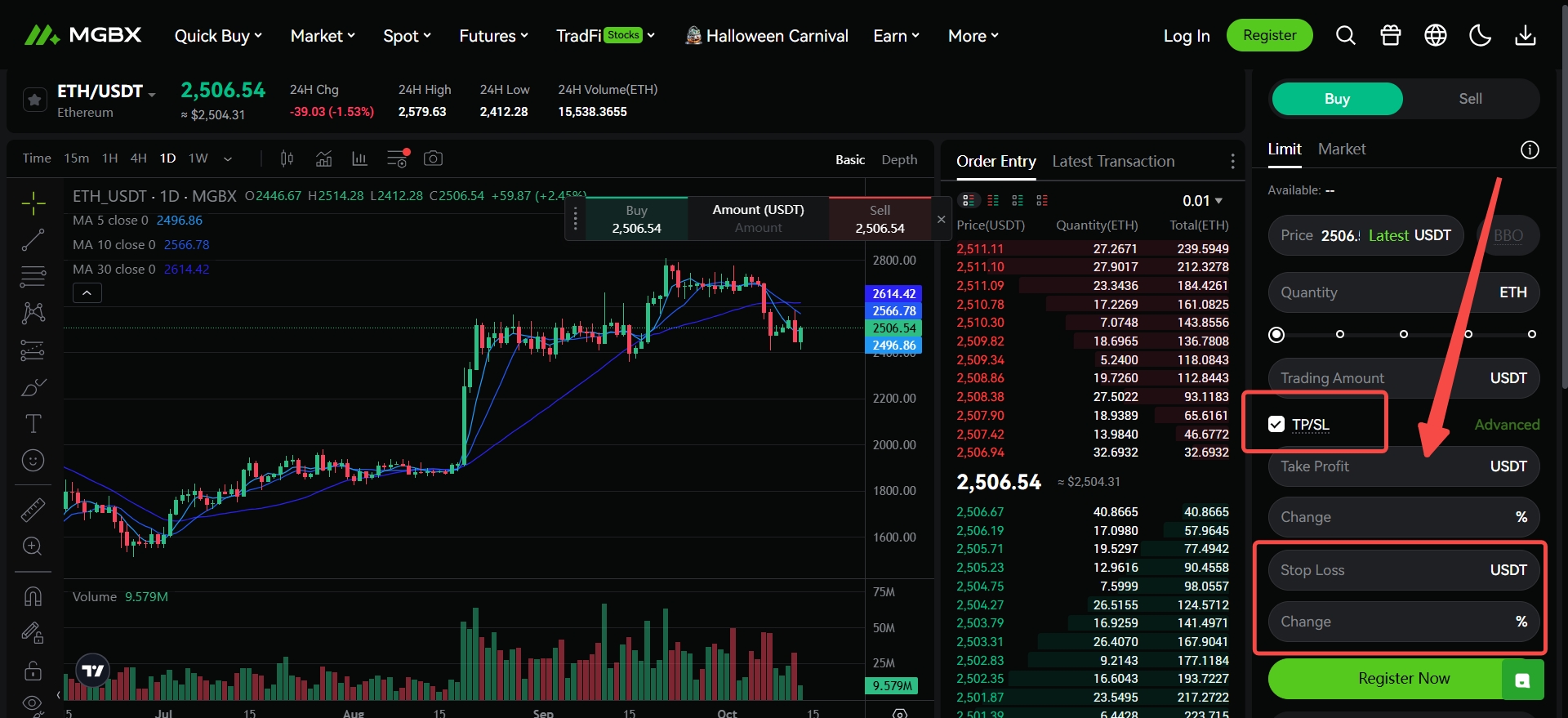
The stop-loss percentage can be calculated as:
Stop-loss percentage = (Entry price - Stop-loss price) ÷ Entry price = (3500 - 3250) ÷ 3500 ≈ 7.1%
This means the maximum planned loss for this trade is about 7.1%. Traders can calculate an appropriate position size based on their personal risk tolerance rather than considering risk only after entering the trade.
Common stop-loss strategies: fixed, technical, and trailing stops
Different trading styles require different stop-loss methods.
Fixed percentage stop-loss:
This method sets a predetermined exit level, such as closing a position when losing 5% or 8%. It is suitable for rule-based trading strategies but may not effectively adapt to changing market volatility.
Technical structure stop-loss:
This method determines exit levels based on market structure, such as support levels, trendlines, previous lows, or key moving averages. When these important levels are broken, it usually indicates that the original trading assumption has changed. For example, a trader buys BTC after a long-term resistance breakout, but the price falls back below the breakout range and fails to rebound; this breakout may be considered invalid, and the position should be reassessed.
Volatility-based stop-loss:
The crypto market often experiences sudden volatility expansions. Some traders use indicators like ATR (Average True Range) to adjust stop-loss distances. During periods of increased volatility, widening the stop-loss range and reducing position size can help reduce unnecessary stop-outs caused by normal market fluctuations.
Trailing stop-loss:
Trailing stops are mainly used to protect profits. As the price moves favorably, traders gradually raise the stop-loss level to lock in gains while leaving room for further upside.
For example, after a trader buys BTC and the price rises from 100,000 USDT to 115,000 USDT, the stop-loss level may be raised to 110,000 USDT. If the market continues to rise, the stop-loss can be adjusted further; if the trend reverses, it can protect existing profits.
Stop-loss should be combined with position management for complete risk control
Stop-loss is not an independent trading tool and should be used in conjunction with position management to build a comprehensive risk management framework.
Many traders believe that setting stop-loss allows them to increase position size, but effective risk control requires considering account size, risk per trade, and stop-loss distance simultaneously.
For example:
A trader has an account balance of 20,000 USDT and wants to limit the maximum loss per trade to 1%.
Maximum risk per trade:
20,000 USDT × 1% = 200 USDT
If planning to set a 7.1% stop-loss distance for an ETH trade, then:
Position size = Maximum risk amount ÷ Stop-loss percentage = 200 USDT ÷ 7.1% ≈ 2,816 USDT
This means that even if the trader has a strong bullish view on ETH, the position size should be determined by risk limits rather than investing the entire account balance.
Stop-loss in spot trading and futures trading also differ in practical application:
Comparison | Spot Trading Stop-Loss | Futures Trading Stop-Loss |
Risk Source | Asset price decline | Price volatility + leverage amplification + margin risk |
Main Objective | Limit asset depreciation | Prevent loss expansion and avoid liquidation |
Stop-loss Range | Usually more lenient | Usually requires stricter control |
Key Factors | Entry price, market trend | Entry price, leverage, margin, funding rate |
Maximum Risk | Long-term asset decline | Rapid loss or liquidation |
Common Tools | Limit stop-loss, market stop-loss | Stop orders, position reduction, combined take-profit and stop-loss |
For perpetual contract traders, stop-loss is even more important. Leverage improves capital efficiency but also reduces tolerance for adverse price movements. Therefore, traders need to consider leverage multiples, margin ratios, liquidation distance, and execution risk when applying stop-loss strategies.
In the long run, the value of stop-loss is not to reduce trading opportunities but to keep traders active and participating in future market opportunities.
Frequently Asked Questions
Does setting a stop-loss mean the trade has failed?
No. Stop-loss means the trader follows preset risk management rules. Accepting small losses is a normal part of a mature trading system.What stop-loss percentage should crypto traders use?
There is no unified percentage. The appropriate stop-loss level depends on asset volatility, trading timeframe, and strategy type. BTC, ETH, and high-volatility altcoins usually require different stop-loss ranges.Why does the price often rebound after triggering a stop-loss?
This may be because the stop-loss is set too close to normal market fluctuations or short-term liquidity zones. Traders can optimize stop-loss placement by considering market structure and volatility.Are trailing stops suitable for all trading strategies?
Not necessarily. Trailing stops work better in trending markets and help protect profits but may cause premature exits in ranging markets.Which is more important, stop-loss or position management?
Both are important. Stop-loss defines the maximum loss boundary, while position management determines actual risk exposure. Together, they form a complete trading risk management system.
Mastering the basics is the first step. Follow MGBX Academy to access more cryptocurrency educational resources and market opportunities.
The process for trading on MGBX:
Register a trading account and complete the necessary identity verification;
Deposit funds and select a trade type;
On the cryptocurrency trading page, enter the amount or quantity of the cryptocurrency you wish to purchase;
Confirm the order to complete the trade, and check that your assets have increased accordingly.
Related reading:
Complete Guide to Crypto Trading Risk Management
Position Management: Why You Should Never Bet Your Entire Account
Risk-Reward Ratio and Win Rate: Core Metrics of a Trading System
Risk-Reward Ratio Calculation: A Must-Do Step Before Every Trade