What Does Number Go Up Mean? Crypto Meme Culture, Market Psychology, and Supply and Demand
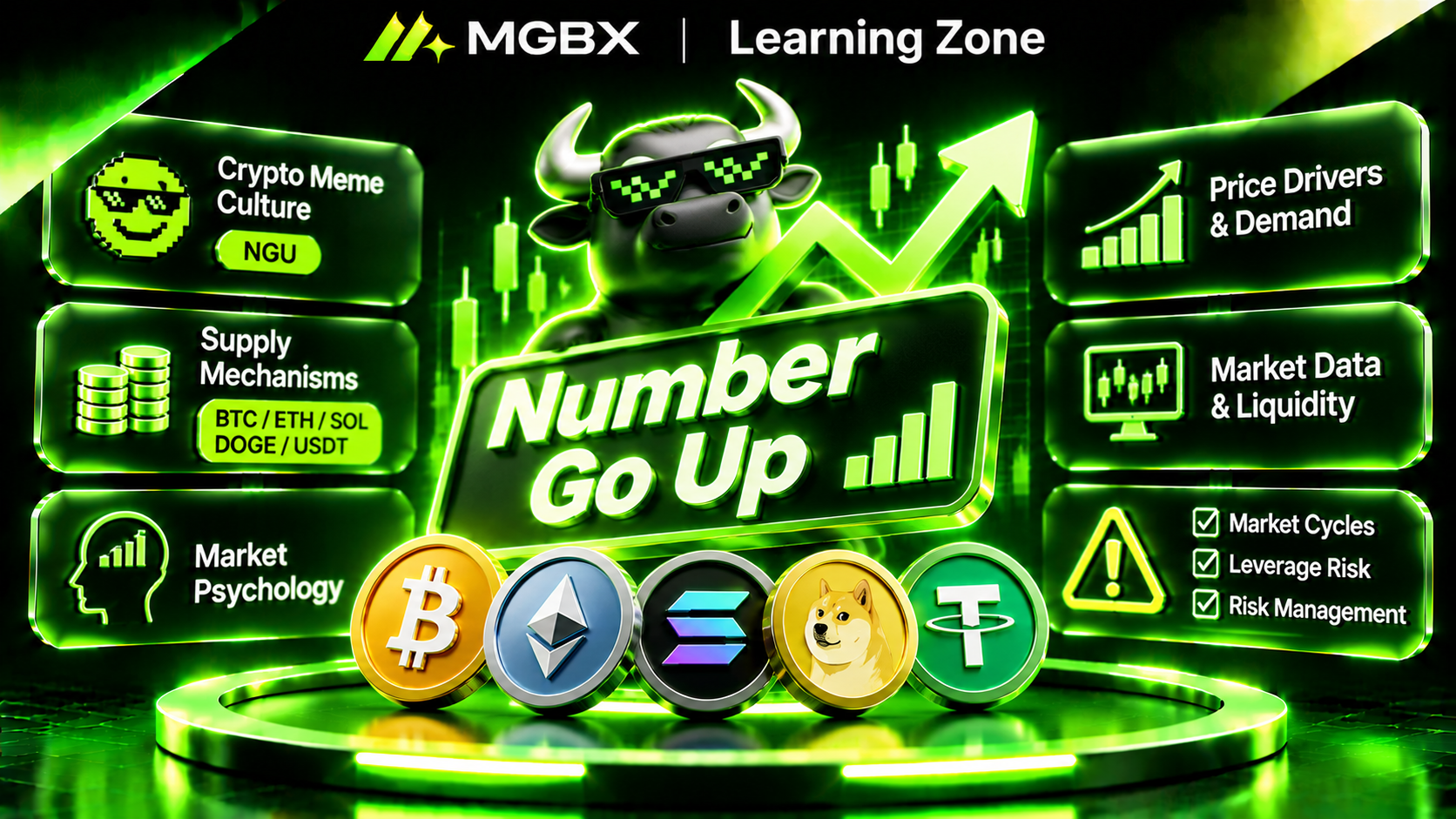
Number Go Up is a widely used meme in the cryptocurrency community that humorously describes investors' expectations of continuously rising digital asset prices. It reflects both the long-term value narrative surrounding Bitcoin's limited supply and network effects, and the crypto market's sensitivity to price momentum and collective sentiment. However, different tokens have distinct supply mechanisms, practical demand, and economic models. Understanding this meme requires examining BTC's scarcity, ETH's issuance and burning, SOL's inflation mechanism, and DOGE's ongoing issuance rather than treating upward price movement as a universal market rule.
What Does Number Go Up Mean? How Did This Meme Emerge in the Crypto Community?
Number Go Up, commonly abbreviated as NGU, literally means that numbers keep increasing. It is a popular expression in cryptocurrency culture used to describe expectations of continuous price appreciation.
The phrase is not a blockchain technology, trading indicator, or formal investment theory. Instead, it is a humorous summary of bullish expectations in the crypto market. During bull markets, users often pair the expression with green price charts, rising market graphs, and profit screenshots. During bear markets, it is also used to criticize the belief that digital asset prices can only increase and never decline.
The term NGU Technology gradually became popular within the Bitcoin community. In 2020, economist Saifedean Ammous used the expression in a podcast discussion about Bitcoin's fixed supply and the relationship between supply and demand.
The underlying argument is that when an asset has limited supply while market demand increases, upward price pressure may develop.
However, NGU is not a mechanism that guarantees Bitcoin price appreciation. It is primarily a cultural expression. Actual asset prices continue to depend on supply and demand, liquidity, market expectations, and broader economic conditions.
BTC, ETH, SOL, DOGE, and USDT: How Do Their Price and Supply Mechanisms Differ?
Understanding NGU requires distinguishing the supply mechanisms and demand drivers of different crypto assets. Although they all have market-determined prices, their underlying economic models differ considerably.
According to the CoinMarketCap market data snapshot on November 23, 2026, BTC had a market capitalization of approximately $1.22 trillion, ETH approximately $208.5 billion, SOL approximately $41.6 billion, DOGE approximately $8.6 billion, and USDT approximately $174.7 billion. These differences illustrate the varying market sizes and levels of investor participation across asset categories.
Asset | Supply Mechanism | Primary Value Drivers |
BTC | Maximum supply capped at 21 million | Scarcity, network security, and market demand |
ETH | Supply changes through validator issuance and transaction fee burning | Smart contract ecosystem and network usage |
SOL | Issued according to a predefined inflation schedule to reward validators | Network activity, staking demand, and ecosystem growth |
DOGE | No fixed maximum supply; ongoing block rewards | Community culture, payment use, and market sentiment |
USDT | Circulating supply adjusts according to issuance and redemption demand | U.S. dollar liquidity and trading settlement demand |
Bitcoin has a maximum supply of 21 million coins, with block rewards approximately halving every four years. Following the April 2024 halving, the block reward decreased to 3.125 BTC. After the next halving, it is expected to fall to 1.5625 BTC.
Bitcoin's fixed supply and declining issuance are central to the NGU narrative. However, whether demand continues to grow remains a decisive factor in its market price.
Ethereum's supply mechanism works differently. ETH has no fixed maximum supply. The network issues new ETH through validator rewards while burning a portion of transaction fees based on network activity. When the amount burned exceeds the amount issued, ETH supply may decrease. When issuance exceeds burning, supply may increase. This means ETH supply changes are linked to network usage.
SOL uses an inflation-based issuance mechanism to incentivize network security and validator participation. According to Solana's official documentation, its inflation schedule starts at 8%, decreases by 15% annually, and targets a long-term inflation rate of 1.5%. This means SOL supply continues to increase, although the inflation rate gradually declines according to the predefined schedule.
DOGE, on the other hand, has no fixed maximum supply. It currently generates a block reward of 10,000 DOGE approximately every minute, resulting in annual new issuance of approximately 5.26 billion DOGE.
As total supply expands, annual issuance represents a progressively smaller proportion of the existing supply. However, this model remains fundamentally different from Bitcoin's fixed supply structure.
USDT represents another category of asset. Its objective is to maintain a value close to the U.S. dollar, rather than generate returns through unit price appreciation. An increase in USDT market capitalization generally reflects growing demand for dollar-denominated stablecoins or an expansion in issuance. It does not mean that the unit price of USDT is expected to rise continuously.
Therefore, NGU cannot be used as a universal explanation for every crypto asset. Bitcoin's scarcity, Ethereum's network usage, Solana's ecosystem demand, and Dogecoin's community sentiment require separate analysis.
Market Psychology, Price Data, and Risk Management Behind Number Go Up
From a market psychology perspective, NGU reflects investors' expectations of positive feedback from rising prices. When BTC or popular tokens appreciate, social media discussions and market attention may increase, attracting additional capital and potentially pushing prices higher.
However, this feedback mechanism can also work in reverse. When prices begin to fall, investors may reduce risk exposure simultaneously, resulting in lower liquidity and increased selling pressure.
Market conditions on November 23, 2026, provide a useful example. According to CoinMarketCap's global cryptocurrency market data, total crypto market capitalization was approximately $2.08 trillion, while the market sentiment indicator was in the Extreme Fear range, with a reading of 9.
Even though Bitcoin still had a market capitalization of approximately $1.22 trillion, market participants were not necessarily optimistic.
This demonstrates that a large market capitalization does not mean prices can only move upward. Investors need to distinguish long-term asset narratives from short-term market sentiment.
Comparing BTC, ETH, SOL, and DOGE also reveals different drivers behind price appreciation.
BTC depends more heavily on scarcity, institutional participation, and long-term demand. ETH requires monitoring decentralized application activity, transaction fees, and changes in issuance and burning. SOL requires attention to network usage, staking participation, and ecosystem development. DOGE depends more on community exposure, payment demand, and the market's ability to absorb newly issued supply.
In practical trading, investors can monitor three key areas:
Changes in market capitalization and circulating supply to determine whether price appreciation is supported by actual demand.
Trading volume and market depth to assess whether price movements are supported by sufficient liquidity.
Funding rates and open interest in derivatives markets to identify excessive leverage and crowded trading positions.
NGU helps explain the optimistic side of crypto culture, but it cannot replace fundamental research. For MGBX users, a more disciplined approach is to combine price trends, asset supply, and market liquidity when setting position sizes and exit rules, rather than trading solely on the belief that prices will keep going up.
Mastering the basics is the first step. Follow MGBX Academy to access more cryptocurrency educational resources and market opportunities.
The process for trading on MGBX:
Register a trading account and complete the necessary identity verification;
Deposit funds and select a trade type;
On the cryptocurrency trading page, enter the amount or quantity of the cryptocurrency you wish to purchase;
Confirm the order to complete the trade, and check that your assets have increased accordingly.